
 Facebook
 Instagram
 X (Twitter)
 TikTok
 Pinterest
 YouTube
 LinkedIn
 Threads
 Google Business Profile
 Telegram
 Discord
How to Market a Clothing Brand on Social Media: A Guide for Small Labels


A garment on a hanger tells a buyer almost nothing. Not how it falls, not how it moves, not whether the shoulder will sit right on a body like theirs. That one gap decides most of what a clothing brand has to do on social media, because the flat lay that works perfectly as a product photo is the post everybody scrolls past.
The brands that do well solve it early. They show the clothes worn, on more than one body, moving. Then they worry about captions, hashtags and how often to post.
This guide covers which channels return the effort for apparel, what to post when you have no new drop, how to get on-model shots without booking a studio, the content that quietly prevents returns, and a weekly plan one person can keep up. Yoomru, the app we make, appears near the end where it is relevant, and we say so clearly.
Quick answer
Put Instagram first, TikTok second and Pinterest third. Post the garment worn far more often than the garment alone, and lead with video, because clothing is a category people judge in motion. Build content around outfits, fit and occasions rather than SKUs.
| Channel | Why it matters for clothing | Realistic effort |
|---|---|---|
| Reels carry the reach, carousels carry the detail, Stories carry the conversation. It is where a clothing brand becomes recognisable. | Highest return per hour. Three to five posts a week plus Stories. | |
| TikTok | Try-ons, styling and packing travel further here than anywhere else, and the account does not need a following to start. | Two to four clips a week if you enjoy video. |
| People plan outfits and wardrobes there, and pins keep being found months later. Slow, and it compounds. | A few pins most days, mostly recycled images. | |
| Your existing buyers, restock news, longer captions, local pickup and community groups. | Two posts a week, mostly reshared. | |
| YouTube Shorts | A free second home for clips you already made for TikTok and Reels. | Reupload, nothing more. |
Why clothing is different from other products
Most ecommerce advice assumes a product whose job you can explain. A dress has no features to list. What it has instead is a specific and stubborn set of objections, and your content exists to answer them:
- Fit. "Will this sit right on me?" stops more carts than price does, and it is why apparel carries the highest return rates in ecommerce. A size chart is a table. A person of a stated height wearing a stated size is an answer.
- Drape and weight. Whether a fabric hangs, clings, holds its shape or creases is something a still photograph struggles to say and three seconds of walking says immediately.
- Colour. Screens lie about ecru, olive and navy more than any other colours, and those are exactly the shades small brands love.
- What it goes with. Nobody buys a single garment in the abstract. They buy the outfit they can already picture.
There is one more difference that shapes everything: apparel is the most crowded category on social media. Every scroll already contains a flat lay on a white background and a model in a field. Being a bit better at the same thing does not work. Being specific does: your fabric, your fit, your person, your studio, said out loud.
And unlike a poster or a mug, clothing has a season. A piece released in March is harder to sell in October, which means a clothing brand cannot simply recirculate its whole back catalogue forever. It can recirculate the half that is still in stock and still in season, which is a different and slightly more demanding job.
Where to put your effort, channel by channel
Instagram, first
Instagram is where a clothing brand builds a look people recognise. Three formats carry the weight:
- Reels. The garment on a person, moving. A turn, a walk, a fit check, three ways to wear one piece. This is where people who have never heard of you find you, and it is worth being deliberate about, which is why it has its own guide: Instagram Reels for clothing brands.
- Carousels. The format that answers questions. One garment on three bodies. One piece styled three ways. Front, back, detail, fabric, and the label with the fibre content. Carousels are where you put everything a product page should say and usually does not.
- Stories. The cheapest useful surface you have. "This or that" polls, size questions answered out loud, packing orders, a restock countdown, a mirror in the studio.
One correction to the usual advice, because it changes how you split your week: Reels are not the biggest-reach format. Benchmark studies across tens of millions of Instagram posts find carousels out-viewing Reels at every account size, because a carousel gets a second pass through the feeds of people who already follow you. What Reels do that carousels cannot is reach people who do not. Post both, and stop treating a quiet Reel as a failure.
Feed images have one technical constraint worth knowing: Instagram accepts aspect ratios between 4:5 and 1.91:1, so a tall 9:16 product shot will be cropped or padded. Cut a 4:5 for the feed and keep the 9:16 for Stories and Reels. More formats in promoting Shopify products on Instagram.
TikTok
TikTok rewards the parts of running a clothing brand you think nobody wants to see: cutting, sampling, checking a seam, steaming, folding, taping the mailer, opening a box of new stock. It also rewards the honest try-on, the one where you say a size runs small.
The useful thing about TikTok for a small brand is that it does not require an audience first. A clip about "the jacket everyone asks about" can reach people who have never heard of you. The cost is that it wants frequency and it wants you on camera, or at least your hands. If neither appeals, skip it rather than doing it badly. See promoting Shopify products on TikTok.
Pinterest is not a feed, it is a search engine people use while planning: "capsule wardrobe autumn", "linen dress outfit", "what to wear to a garden wedding". Clothing sits right in the middle of that, and a pin keeps surfacing for months after you publish it.
The work is low because the images already exist. Cut a tall 2:3 crop of the on-model shot you made for Instagram, write a real description, organise boards by outfit and occasion rather than by collection. The walkthrough is how to promote Shopify products on Pinterest.
Facebook is where your existing customers already are and it tolerates a longer caption than anywhere else. Use it for restock announcements, collection stories, size and fabric explainers, market and pop-up dates, and albums of a whole drop. Reshare what you made for Instagram rather than writing something new. See promoting Shopify products on Facebook.
The rest
YouTube Shorts is a free second home for every TikTok clip you make, and it is worth the upload for that reason alone: promoting Shopify products on YouTube Shorts. Keep a Google Business Profile current if you have a shop, a studio or a market stall people can visit. Threads and X matter mainly if you enjoy writing.
How to promote a clothing brand with no budget
Almost every small apparel brand arrives at the same short list when the money runs out: run some ads, gift some product to an influencer, hope. The first two are where most of the wasted money goes, and the honest ordering is close to the reverse.
- Post the thing that answers the objection. Fit, fabric, size, what it goes with. Free, and it is the content that converts, not the content that reaches.
- Ask your existing customers for the photo. A card in the box asking buyers to tag you when they wear it costs pennies and produces the only images nobody suspects of being staged. Reshare with credit and permission.
- Answer publicly. Every fit question in your inbox is a post. If one person asked, forty wondered.
- Show the work. Cutting, sampling, packing, a fitting. It costs nothing and it is the reason someone buys from you rather than a marketplace.
- Then, and only then, gifting. Brands who have tried it describe the same pattern: written agreements, clear deliverables, real product cost, no sales. It can work, but it is a paid channel with a delayed and unreliable payout, not a free one.
The unglamorous truth is that the cheapest lever a small brand has is frequency, and the second cheapest is being specific. Neither costs money and both are harder than buying reach.
What a clothing brand actually posts
The hard part is not strategy, it is having something to post on Tuesday when there is no new drop. These formats suit apparel, and most can be built from images you already have.
| Format | What it is | Best on |
|---|---|---|
| On-model shot | The garment worn, in daylight, full length and half length | Instagram, Pinterest |
| Fit check | A whole outfit, head to toe, with the pieces and sizes said out loud | Reels, TikTok |
| Fit reference | The same size on two or three different bodies, with heights and sizes stated | Instagram carousel, Stories |
| Styled three ways | One piece, three outfits, one clip or one carousel | Reels, TikTok |
| Movement clip | A turn, a walk, a sleeve lifted, so the fabric shows what it does | Reels, TikTok |
| Detail crop | Weave, stitching, buttons, lining, the care label | Instagram, Pinterest |
| Flat lay of an outfit | The whole look laid out, including what you do not sell | Pinterest, Instagram |
| Process | Cutting, sampling, dyeing, pressing, a fitting | TikTok, Reels |
| Packing an order | Tissue, card, sticker, the mailer going out | TikTok, Stories |
| Restock or last sizes | What came back in, what is nearly gone | Stories, Facebook |
| Customer photo | A buyer wearing it, shared with permission | Everywhere |
| Size and fit answer | A real question from a real message, answered on camera | Stories, Reels |
| Seasonal edit | A themed group at a price point: holiday, wedding guest, back to work | All, in season |
A workable ratio is half on-model and lifestyle, a quarter education and answers, a quarter product or offer. If every post is a garment with a price under it, the account stops being worth following. More starting points in social media content ideas for Shopify stores.
On-model shots, the asset that does the most work
If you make one change this month, make it this: stop posting the garment on its own.
Your product photo is still the flat one, because that is what a product page needs and what a buyer wants to inspect. Shoot it flat or on a ghost mannequin, straight on, against a plain background, with the colour as true as you can get it.
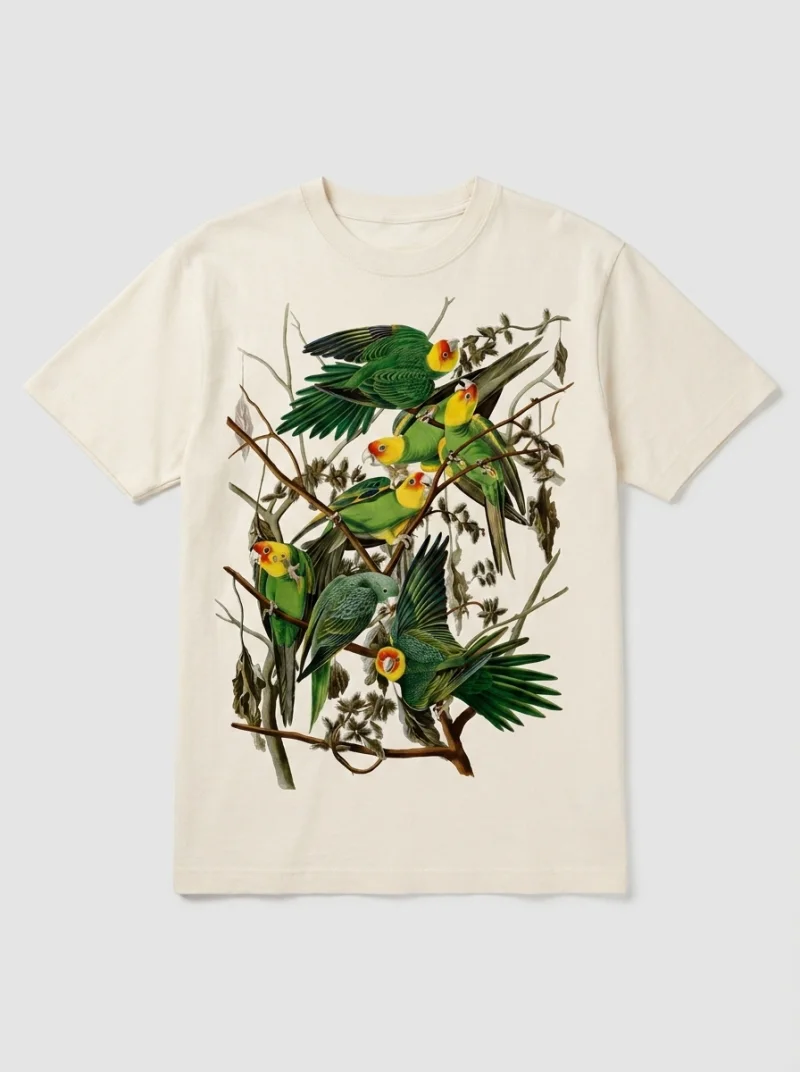
That file is the raw material. What you post is the same garment worn, and there are three ways to get there. Most brands end up using all three:
- Photograph a real person. A friend, a colleague, yourself. Cheapest and by far the most honest, because a real body at a stated height and size answers the fit question in a way nothing else does. The limit is scheduling: you cannot shoot every colourway and every size this way.
- Hire a model and a studio. Best images you will get, and the right call for a lookbook or a launch. It is also the reason most small brands have twelve good photos and then nothing for eight months.
- Generate the shot. A photographed person, your garment placed onto them by a try-on model. Cheap per image and workable across a catalogue, with real caveats about what it can and cannot be used for.
All three, including what makes a generated shot believable and the mistakes that give one away, are covered in how to photograph clothing without a model.
Here is the third one in practice. The scene was photographed and authored once, and the garment is the flat lay above:
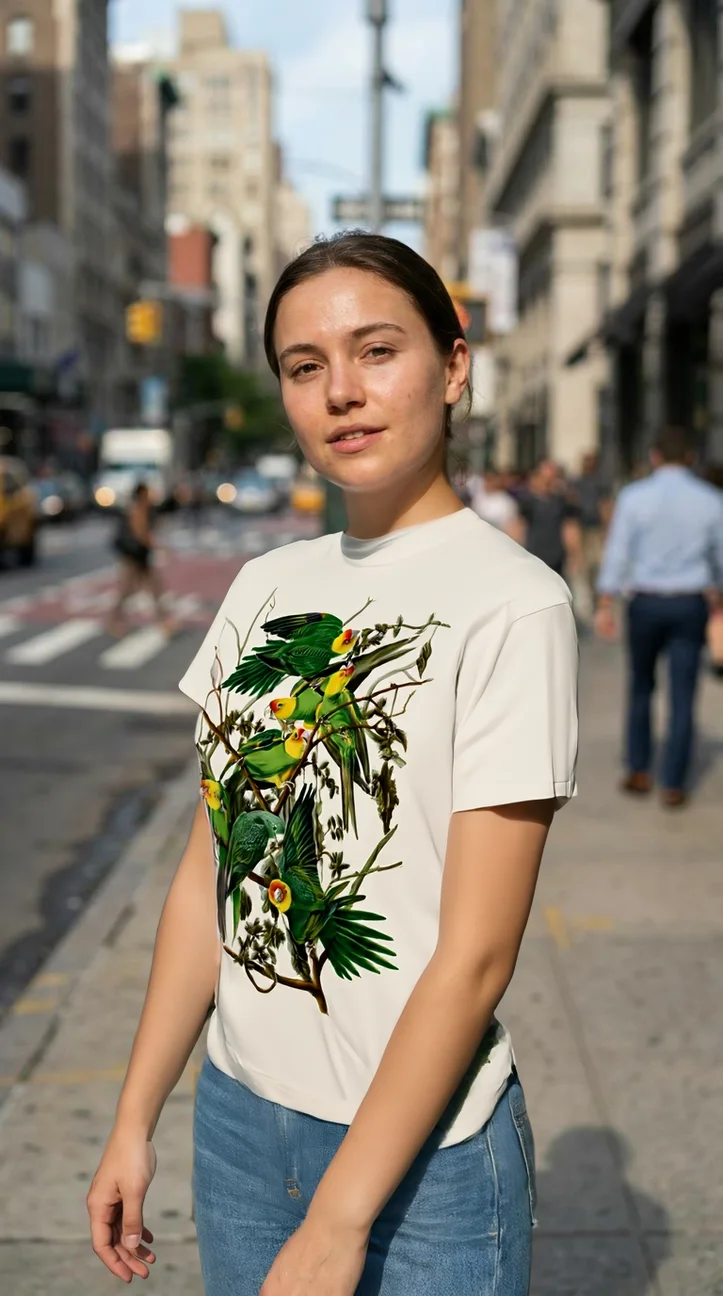
And the same garment, same flat lay, in a second scene:
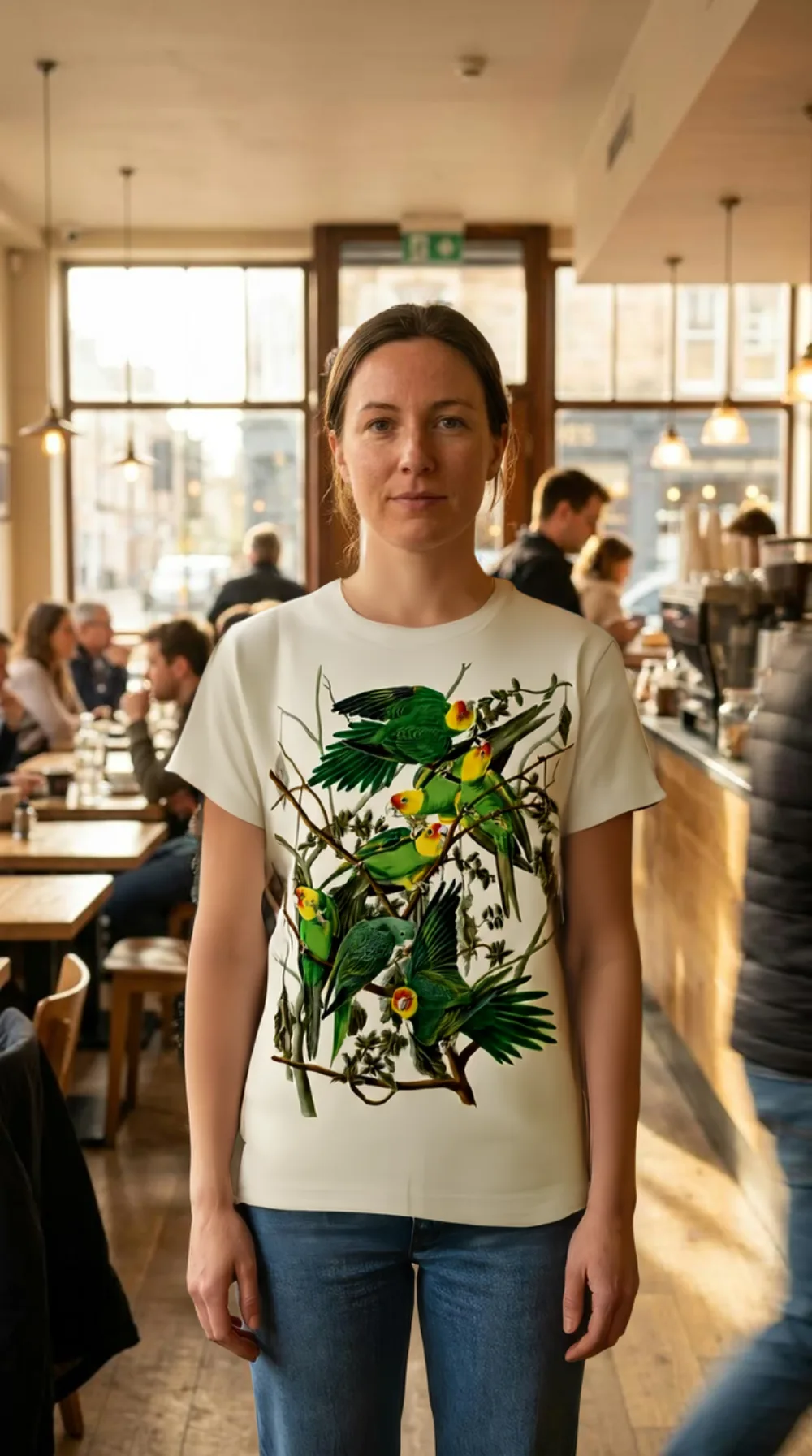
Two rules hold whichever route you take. The garment has to be the garment. Right colour, right length, right neckline, the print at the size you actually print it. If a generated image invents a detail or resizes your graphic, throw it away. And the shot must not oversell the fit. A photo that shows a relaxed tee as fitted is a return waiting to happen, whether a camera or a model made it.
One more rule that is not aesthetic. If an image is AI generated, label it. TikTok requires it outright for realistic-looking people and scenes, Meta adds a label of its own when it detects one, and Google Shopping wants a metadata tag on generated product images. Advertising law goes further than any of them: an image must not misrepresent the product, and no disclosure rescues one that does. The full version of that, including where the line sits for AI models, is in the photography guide linked above.
Sizing content, and why it is worth more than it looks
Apparel has a problem no other category has at the same scale: a large share of what you ship comes back, and most of it comes back because it did not fit. Every return costs you the shipping twice, the handling, and sometimes the item.
Which makes this the most valuable content a clothing brand produces, and almost nobody makes enough of it:
- State the model's height and the size she is wearing, every time, in the caption. It costs four words.
- Show the same size on two different bodies. One carousel, two people, sizes and heights written on the images.
- Say how it runs. "Runs small, size up if you are between sizes" in your own voice beats a size chart nobody opens.
- Show the fabric doing its thing. Stretch it, sit down in it, say whether it creases.
- Answer real messages publicly. If one person asked, forty wondered.
None of this looks like marketing, which is exactly why it works. It is also the cheapest content you will ever make, because it is a phone, a person and a sentence. A proper size chart on the product page is the other half of the job, and there are apps for that in the best Shopify size chart apps.
How often to post, and a weekly workflow
Consistency beats volume, and the plan has to survive a busy week. Batch the making on one day, then let the posting happen across the week.
| Day | Channel | Post |
|---|---|---|
| Monday | Instagram, Pinterest | On-model shot of one piece, 4:5 for the feed and a 2:3 crop for the pin |
| Tuesday | Reels, TikTok | Movement clip: a turn, a walk, the fabric doing something |
| Wednesday | Instagram, Facebook | Carousel: one piece styled three ways, or the same size on two bodies |
| Thursday | Reels, TikTok | Process or packing clip |
| Friday | Stories | "This or that" poll, or a size question answered out loud |
| Saturday | Two or three pins from the back catalogue, still in stock, new descriptions | |
| Sunday | Instagram, Facebook | Customer photo, or the story behind one piece |
If that is too much, cut it to three: one on-model post, one clip, one fit or fabric answer. Three a week you keep up beats seven that stop in March. There is a fuller version in our weekly social media schedule, and a look at frequency in how often should a Shopify store post.
One batching habit specific to clothing: when you shoot or generate anything, cut every crop at once. A 9:16 for Reels and Stories, a 4:5 for the feed and a 2:3 for Pinterest out of one scene fill three slots for no extra work.
What normal looks like
Most people running a small clothing brand are measuring themselves against numbers nobody publishes, and concluding they are failing. Some grounding, from benchmark studies that cover tens of millions of posts and thousands of tracked brands:
- Engagement rates in fashion are tiny. Across tracked fashion brands, including household names with millions of followers, the average sits under a fifth of one percent. If yours is higher, you are ahead of companies with marketing departments.
- A few hundred views on a Reel is normal for an account with a few thousand followers. It is not a shadowban and it is usually not the algorithm.
- Most small accounts do not grow in a given year. That is the base rate, not a verdict on your clothes.
- Views are not sales. Brands report clips with tens of thousands of views and no orders, next to quiet posts that sell out a size. Judge the account on revenue and on questions in your inbox, not on the view count.
The practical use of all this is to stop rewriting your strategy every fortnight. Pick the formats, hold the frequency, and change one thing at a time.
Drops, restocks and seasonal timing
Clothing runs on a calendar whether you like it or not. Plan a light theme per month rather than a campaign per week, and remember that the two events that reliably sell for a small brand are a drop and a restock.
| Period | What people are doing | What to post |
|---|---|---|
| January | Resetting, tidying wardrobes, buying basics | Capsule wardrobe pieces, care and repair, end of season sale |
| February | Waiting for spring, buying transitional layers | Layering clips, lighter knits, the first spring colours |
| March and April | Spring wardrobe, occasions starting | New season drop, styling one piece for two temperatures |
| May and June | Weddings, holidays, graduations | Wedding guest edits, packing lists, linen and lightweight fabrics |
| July and August | Sales, holidays, back to school and university | Last sizes, holiday capsules, restocks of the summer best sellers |
| September | The biggest wardrobe reset of the year | Autumn drop, transitional layering, outerwear previews |
| October and November | Coats, gifts, party dressing begins | Outerwear, gift edits by price, party pieces |
| December | Gifts, then panic about delivery | Shipping deadlines, gift cards, easy-to-size pieces like scarves |
Two dates matter more for clothing than for most categories. Post your last order dates for delivery clearly and more than once in December, because a buyer who finds out at checkout does not come back. And treat a restock as a real event: announce it before it lands, on the day, and when the last sizes go. Restock demand is the most reliably wasted asset in small apparel, and a back-in-stock signup on the product page catches the rest of it. There is a roundup in the best Shopify back in stock apps.
Where Yoomru fits
Full disclosure: Yoomru is our app. It is a Shopify app that posts your products to social media, automatically when a product goes live, on a recurring schedule, or by hand from a calendar, across eleven networks. We built it for product catalogues generally, and a few parts of it exist specifically because clothing brands kept hitting the wall described above.
What matters for apparel:
- New pieces post themselves. When a product becomes visible in your store, it goes out to every channel you have switched on, with the text built from the product's own data. A drop of twelve pieces does not become an afternoon of copying and pasting.
- Planners work the back catalogue. A planner picks products matching a collection, tag, type or vendor and posts them on a schedule, in random order, without repeating until it has been through the set. Point one at this season's collection and it keeps the account alive between drops. It skips out-of-stock products by default, which matters more in clothing than anywhere else.
- Collages. Branded still images built from a product's own photos, at square, 4:5, 9:16 or 2:3, with no AI involved. Left on automatic, each post gets the right shape for where it lands. Ten layouts, and one photo is enough.
- On-model scenes. Six clothing scenes we authored ourselves: a mirror selfie, a street walk and a café table for tops, and a turn in daylight, a doorway pose and evening stairs for dresses and outerwear. You send a flat lay or a ghost-mannequin shot, and a garment try-on model puts your piece on the person. The two shots earlier in this post came from the first category.
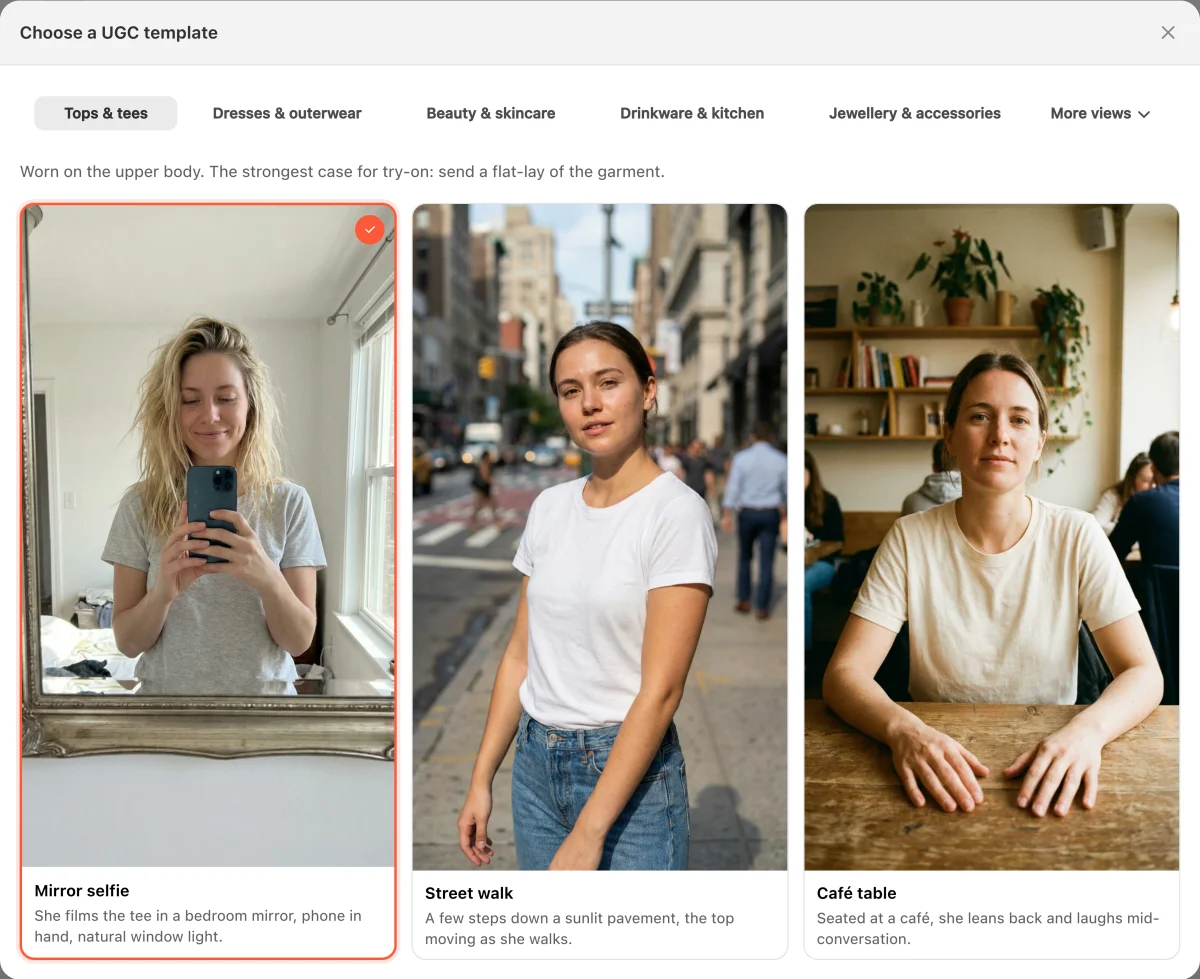
Each scene makes either a still or a five second clip. An AI image costs 15 credits and a clip 50, from a monthly allowance that also pays for AI captions at one credit each: 50 credits on Free, 250 on Starter, 700 on Growth and 1,500 on Pro. The still publishes anywhere, including Pinterest and Google Business Profile, which do not accept generated video. Posts carrying an AI clip get a "Created with AI" line added to the caption by default, and you can reword it or switch it off.
Three honest limits. Six scenes is six scenes: we authored them once and every shop using the category gets the same people, so they are a supplement to your own photography rather than a replacement for it. Generation costs credits, so it suits new pieces and best sellers rather than a thousand SKUs. And try-on works on the garment, not on the fit: it will not tell a buyer how something sits on their own body, which is why the sizing content above still has to come from you.
The free plan publishes real posts rather than previews, and the feature documentation is at yoomru.com/documentations. For how Yoomru compares with other apps in the category, including where it loses, we tested nine competitors hands on in the best Shopify social media auto-post apps.
Checklist before you post
- The garment appears on a body, not only flat or on a hanger.
- The caption says the model's height and the size she is wearing.
- The colour in the image matches the colour that ships.
- There is a version cut for the shape of the channel: 9:16, 4:5 or 2:3.
- The link goes to the product or collection page, not the homepage.
- Anything AI generated is labelled.
- The piece is actually in stock in more than one size.
- Something from the back catalogue is scheduled this week, not only the new drop.
FAQ
Which platform is best for a small clothing brand?
Instagram, then TikTok. Instagram is where a clothing brand builds a recognisable look and where buyers check you out before ordering; TikTok is where people who have never heard of you find you. Pinterest is the slow third that keeps paying, and it costs almost nothing once you have the images.
How often should a clothing brand post?
Three to five times a week on Instagram, including at least two Reels, plus Stories most days. That is the level most small brands can hold. Frequency matters less than not disappearing for three weeks, which is what usually happens.
Do I need a model to sell clothes online?
No, but you need a body. A friend, a colleague or yourself, at a stated height and size, does more for conversion than a professional shoot does, because it answers the fit question honestly. Hire a model when you want a lookbook, not to get through the catalogue.
Are AI generated on-model photos allowed?
They are, with conditions. Label them where the platform requires it, TikTok being the strict one, and never let one misrepresent what arrives: the colour, the length, the print size and the way it fits all have to be true. Advertising rules across most markets treat a misleading product image as a problem regardless of how it was made, and in apparel a misleading image comes straight back as a return. One line that catches people out: never give a generated person words to say about your product, because a testimonial from someone who does not exist is a different and much clearer offence than an image.
How do I market a clothing brand with no money?
Frequency and specificity, in that order. Post the content that answers fit and fabric questions, ask your existing buyers for photos, answer inbox questions in public, and show how the clothes are made. Gifting product to influencers is the thing most brands try first and it is effectively a paid channel with an unreliable payout, so do it after the free things, not instead of them.
What do I post when there is no new collection?
Styling, fit and process. One piece worn three ways, the same size on two people, a fabric close-up, an order being packed, a question from your inbox answered on camera. A brand that only posts when it has something new to sell posts eight times a year.
Should I automate posting?
Automate the repetitive half: sending each new piece out to every channel, keeping the back catalogue circulating, filling the quiet weeks. Keep the rest human: replying to fit questions, judging whether an image is good enough, deciding what a drop is about. Automate the schedule, not the judgment. More on where that line sits in avoiding spammy social media posting.