
 Facebook
 Instagram
 X (Twitter)
 TikTok
 Pinterest
 YouTube
 LinkedIn
 Threads
 Google Business Profile
 Telegram
 Discord
Social Media Marketing for Jewelry Businesses: A Guide for Small Shops


A necklace photographed on a white background is a beautiful, useless picture. It does not say how big the pendant is, what the gold looks like in daylight, or where the chain will sit. Those three questions are most of what stands between a jewellery shop and a sale, and the photo a product page leads with answers none of them.
That shapes everything a small jewellery brand does on social media. Usability research on ecommerce imagery lands in the same place every time: a large share of shoppers try to judge size from the pictures, most sites give them nothing to judge it against, and the ones who cannot tell move on. Where the difference between delicate and statement is a few millimetres, that is expensive.
This guide covers which channels pay back the effort, what to post between collections, how to get the shots without a studio, the words you are allowed to put in a caption about gold and stones, and a weekly plan one person can keep. Yoomru, the app we make, appears near the end where it is relevant, and we say so plainly.
Quick answer
Put Instagram first, Pinterest second and TikTok third. Show every piece worn, and show every piece next to something a person can measure it against. Post about occasions, materials and care far more often than you post about price.
| Channel | Why it matters for jewelry | Realistic effort |
|---|---|---|
| Where a jewellery brand becomes recognisable, and where a buyer checks you out before ordering. | Highest return per hour. Three to five posts a week plus Stories. | |
| People plan weddings, outfits and gifts there, and a pin keeps being found for months. | A few pins most days, mostly recycled images. | |
| TikTok | Making, setting, polishing, packing. Craft does unusually well here, and you need no following to start. | Two to four clips a week if you enjoy video. |
| Existing buyers, restocks, longer stories about materials, market dates. | Two posts a week, mostly reshared. | |
| YouTube Shorts | A free second home for clips you already made for TikTok and Reels. | Reupload. |
Why jewelry is different from other products
Most ecommerce advice assumes a product whose job you can explain in a bullet list. Jewellery has no features to list. It has a short set of stubborn objections instead, and your content exists to answer them.
- Scale. "18mm pendant" is a number nobody can picture. A pendant against a collarbone, a ring on a finger, a stud beside a fingertip is an answer. It is the biggest gap in small jewellery shops and the cheapest to close.
- Metal colour. Screens lie about yellow gold, rose gold and champagne finishes, and a buyer who expected warm and unwrapped pale feels misled even when nothing was misdescribed.
- Length and drop. A 45cm chain lands somewhere different on different people, and where an earring stops relative to the jaw decides whether someone buys it.
- Will it last, and will it mark me? Tarnish and green skin are things people search before buying, and skin sensitivity is not niche: in one large European patch-test study around a fifth of the women tested were sensitised to nickel. Saying plainly what your pieces are made of is a selling point.
- What it goes with. Nobody buys a piece in the abstract. They buy the stack, the pairing, or the occasion they can picture.
The return pattern is not the apparel one either. Returns data across thousands of ecommerce brands shows accessories and jewellery coming back mostly for style and preference rather than sizing, which is another way of saying "it was not what I pictured". That is a content problem, and pictures fix it. And jewellery is a gift category to a degree clothing is not: a good share of your buyers will never wear the piece, cannot judge it on a body, and are shopping to a deadline.
Where to put your effort, channel by channel
Instagram, first
Instagram is where a jewellery brand builds a look people recognise. Three formats carry the weight.
- Carousels. The format that answers questions, and the one benchmark studies repeatedly find out-performing everything else. One piece: worn, in the hand for scale, a macro of the setting, the clasp, the stamp. Five slides and it is a whole product page.
- Reels. Where people who have never heard of you find you. Jewellery has an unfair advantage in video: it moves and catches light, and light is what a still cannot show.
- Stories. The cheapest useful surface you have: polls between two finishes, chain length questions answered out loud, a piece being polished, an order going into its box.
One constraint jewellery photographers keep tripping over: Instagram accepts feed images between 4:5 and 1.91:1 and resamples anything much wider than 1,440 pixels, so a 4,000 pixel macro of a pavé setting does not stay one. Crop tighter rather than uploading bigger. More in promoting Shopify products on Instagram.
Pinterest is not a feed, it is a search engine people use while planning: "gold cuff outfit", "minimalist bridal jewellery", "gift ideas for her". Pinterest's own figures put the great majority of top searches as unbranded, which is exactly the condition an unknown shop needs, and it reports its luxury audience buying watches and jewellery at a far higher rate than shoppers elsewhere.
The work is low because the images already exist: a 2:3 crop of the worn shot you made for Instagram, a real description, boards named after occasions rather than collections. The walkthrough is Pinterest for jewelry businesses.
TikTok
TikTok rewards the parts of making jewellery you assume nobody wants to see: sawing, filing, soldering, setting a stone, the moment a piece comes out of the polisher. It also rewards the honest answer, the one where you say a chain is finer than it looks in photos.
Check one thing before you build a business on it. Posting clips is open to everyone, but selling through TikTok Shop is not: jewellery needs category approval first, with origin documentation for gold, laboratory reports for diamonds and coloured stones, and no pre-owned fine jewellery without permission. See promoting Shopify products on TikTok.
The rest
Facebook is where your existing customers already are, and it tolerates a longer caption than anywhere else: restocks, collection stories, materials explainers, market dates, all reshared rather than written twice (promoting Shopify products on Facebook). YouTube Shorts is a free second home for every TikTok clip (promoting Shopify products on YouTube Shorts). Keep a Google Business Profile current if you have a studio or a stall people can visit, because "jewellery repair near me" is a search your website will never win.
Jewelry marketing ideas that cost nothing
Almost every small shop arrives at the same list when the money runs out: run ads, gift a piece to an influencer, hope. The honest ordering is close to the reverse.
- Post the thing that answers the objection. Scale, length, metal, care. Free, and it converts rather than merely reaching.
- Ask your buyers for the photo. A card in the box asking people to tag you produces the only images nobody suspects of being staged. Reshare with credit and permission, and see using product images and reviews.
- Answer publicly. Every inbox question about chain length or tarnish is a post. If one person asked, forty wondered.
- Show the making, and name the occasion. The process is more watchable than the product here, and a piece described as "a gift for a first anniversary" gets found by people who would never search its name.
What a jewelry shop actually posts
The hard part is not strategy, it is having something to post on a Tuesday with no new collection. These formats suit jewellery, and most use images you already have.
| Format | What it is | Best on |
|---|---|---|
| Worn shot | The piece on a body, at the distance a person would actually see it | Instagram, Pinterest |
| Scale shot | The piece against a hand, a coin or a fingertip, so the size is unarguable | Everywhere |
| Macro detail | The setting, the solder seam, the texture, the clasp, the stamp | Instagram, Pinterest |
| Turn in the light | Three seconds of the piece rotating, the only way to show how a stone behaves | Reels, TikTok |
| Bench process | Sawing, filing, soldering, setting, polishing | TikTok, Reels |
| Materials and care | What the metal is, what the plating is, how to clean it, what you will fix | Facebook, carousel |
| Customer photo | A buyer wearing it, shared with permission | Everywhere |
| Occasion edit | A themed group at a price point: wedding guest, anniversary, graduation | All, in season |
A workable ratio is half worn and lifestyle, a quarter education, a quarter product or offer. If every post is a piece with a price under it, the account stops being worth following. More in social media content ideas for Shopify stores.
The two shots that do most of the work
If you change one thing this month: stop posting the piece on its own.
Your product photo is still the clean one: that is what a product page needs and what a buyer wants to inspect. Straight on, plain background, colour as true as you can get it, sharp on the part that carries the price.
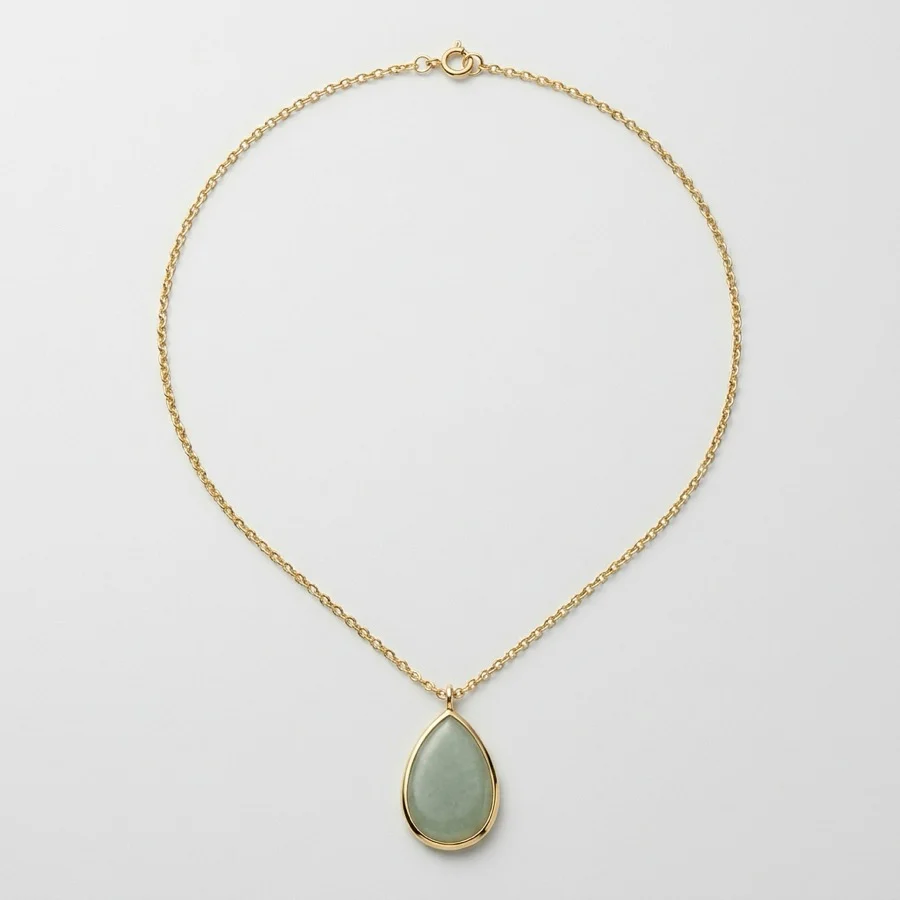
That file is the raw material. What you post is the same piece on a person, at the distance someone would see it, so the size answers itself.
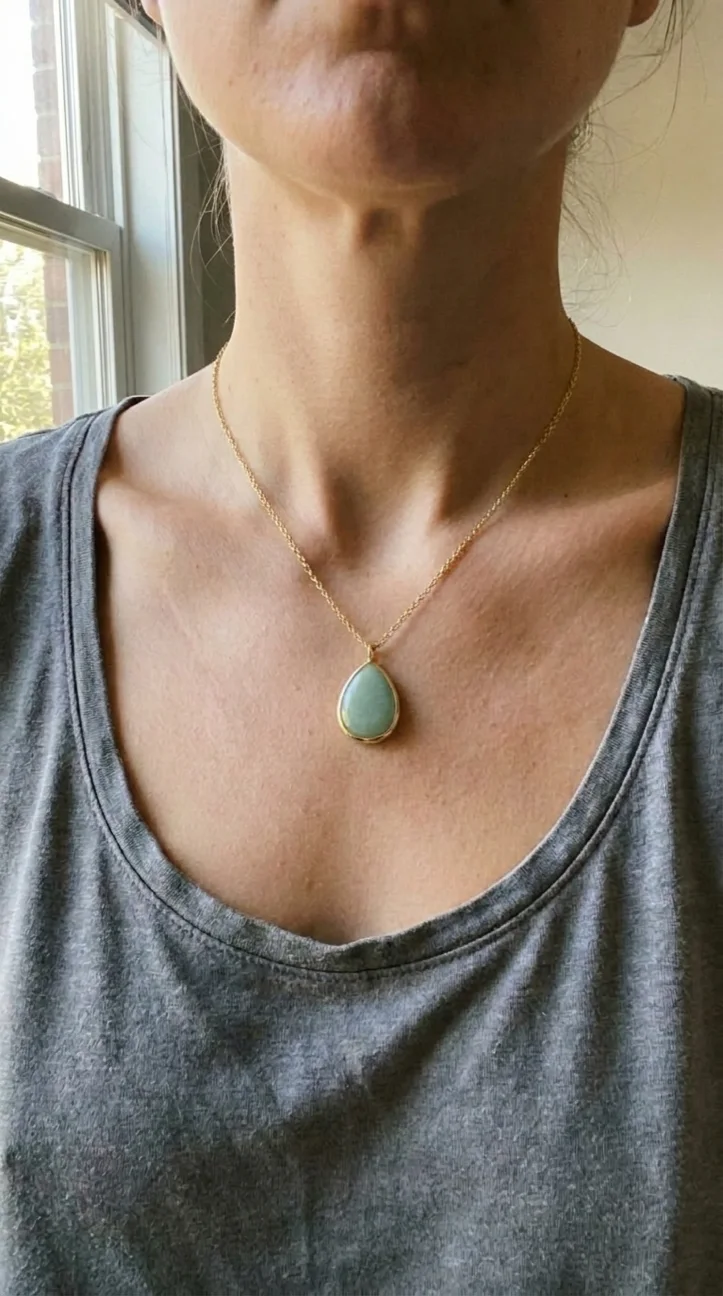
There are three ways to get that second picture, and most shops use all three: photograph a real person, hire a model and a studio for the few pieces that carry the brand, or generate the shot from your own product photo. All three, and the checks that keep a generated image honest, are in jewelry product photography at home.
A second piece, in a second scene, from the same pipeline:

Two rules hold whichever route you take. The piece has to be the piece: right metal colour, right stone shape, right chain, right size against the body. If an image invents a detail, resizes a stone or turns a clasp into something else, throw it away and make another. And the image must not oversell the size. Depicting a stone larger than it is, without saying so, is a thing jewellery advertising rules warn about specifically, and it comes back as a return.
What you are allowed to say about metals and stones
Almost nobody writing about jewellery marketing covers this, and it is the part that can cost you money: jewellery is one of the few categories where the words in your caption are regulated, and a caption is advertising. In the United States the FTC's jewellery guides apply to advertising and every other form of marketing, whether the claim is made in words, symbols, logos or pictures. The rules people break most often are simple ones.
- "Gold" on its own means solid, unalloyed gold. An alloy has to carry its karat fineness immediately before the word, equally prominent. "14K Gold", not "gold" in display type with "14K" underneath in grey.
- "Solid" cannot describe a hollow piece, and hollow pieces have to say so.
- Vermeil has a definition: a sterling silver base, at least 10 karat gold, at least two and a half microns thick. Using it loosely for any gold-plated silver is the most commonly broken rule in direct-to-consumer copy.
- "Sterling" means at least 925 parts per thousand, unqualified "Platinum" means at least 950, and rhodium plating has to be disclosed on anything sold as a precious metal.
- Lab-grown and simulated stones need a qualifier immediately before the stone's name, equally prominent: "laboratory-grown", "laboratory-created" or "simulated". "Faux" is specifically not good enough, and invented varietal names such as "green amethyst" are out.
- Treatments have to be disclosed where the buyer cannot inspect the piece, which online means in the description, not on a separate education page.
Two things catch social sellers in particular. A disclosure belongs early in the product description, not buried at the end or on another page. And a pile of hashtags mixing natural and lab-grown terms confuses rather than discloses: a hashtag is not a disclosure.
In the United Kingdom the mechanism is stricter. Under hallmarking law the offence is applying the description, and the legislation says outright that an advertisement includes a catalogue, a circular and a price list. Calling an unhallmarked piece "gold" in a caption is the offence, whether or not anyone buys. The exemption weights are small, around a gram for gold and under eight for silver, and only apply to pieces of minimum fineness anyway. On plated pieces the word "plated" has to be at least as large as the rest of the description, and "gold vermeil" standing alone is not accepted: it has to read as gold plated silver. The same product can need two descriptions in two markets.
None of this is a reason to write less. It is a reason to write precisely, which is also what sells: "9ct solid gold, 1.2mm cable chain, 45cm" beats "dainty gold necklace" with buyers as well as with regulators.
How often to post, and a weekly workflow
Consistency beats volume, and the plan has to survive a busy week. Batch the making on one day, then let the posting happen across the week.
| Day | Channel | Post |
|---|---|---|
| Monday | Instagram, Pinterest | Worn shot of one piece, 4:5 for the feed and a 2:3 crop for the pin |
| Tuesday | Reels, TikTok | Turn in the light, or a few seconds at the bench |
| Wednesday | Instagram, Facebook | Carousel: worn, in scale, macro detail, the stamp |
| Thursday | Reels, TikTok | Process or packing clip |
| Friday | Stories | Poll between two finishes, or a length question answered out loud |
| Saturday | Two or three pins from the back catalogue, still in stock, new descriptions | |
| Sunday | Instagram, Facebook | Customer photo, or the story behind one piece |
If that is too much, cut it to three: one worn shot, one clip, one answer. Three a week you keep up beats seven that stop in March. There is a fuller version in our weekly social media schedule, and frequency gets its own look in how often should a Shopify store post.
Some grounding, because most people running a small shop measure themselves against numbers nobody publishes. Across benchmark studies covering tens of millions of posts, median engagement on Instagram sits well under half a percent, and in fashion and accessories lower still. A few hundred views on a Reel is normal at a few thousand followers, and views are not sales: shops report clips with tens of thousands of views and no orders next to quiet carousels that sell out a piece. Judge the account on revenue and on questions in your inbox.
The jewelry year
Jewellery runs on a calendar harder than almost any category, because so much of it is bought as a gift. Two things are worth knowing. Gift searching has two peaks rather than one: November and December are the obvious pair, and April and May the second, which most jewellery marketing ignores. And engagement ring research does not spike in December the way proposals do, because people research for months before they buy. Both are arguments for publishing early.
| Period | What people are doing | What to post |
|---|---|---|
| January and February | Newly engaged, planning weddings, then Valentine's | Bridal and wedding party pieces, gift edits by price, shipping deadlines |
| March to June | Mother's Day in both markets, weddings, graduations | Personalised and birthstone pieces, gifts for her, bridal party edits |
| July and August | Holidays, festivals, summer weddings | Everyday and waterproof pieces, layering, travel cases |
| September to December | Autumn reset, gift research, then delivery panic and proposals | New collection, gift guides by price and by person, engraving cut-offs, bridal |
Post your last order dates clearly and more than once in December, and post your engraving cut-off separately, because it is always earlier and buyers never assume that. On Pinterest, start seasonal pushes six to eight weeks before you would elsewhere.
Where Yoomru fits
Full disclosure: Yoomru is our app. It is a Shopify app that posts your products to social media, automatically when a product goes live, on a recurring schedule, or by hand from a calendar, across eleven networks. A few parts of it exist because small shops kept hitting the wall described above.
- New pieces post themselves. When a product becomes visible in your store it goes out to every channel you have switched on, with the text built from the product's own data. A drop of twenty pieces is not an afternoon of copying and pasting.
- Planners work the back catalogue. A planner picks products matching a collection, tag, type or vendor and posts them on a schedule, in random order, without repeating until it has been through the set. Point one at your everyday pieces and it keeps the account alive between collections. It skips out-of-stock products by default, which matters when half your pieces are one-offs.
- Collages. Branded still images built from a product's own photos, at square, 4:5, 9:16 or 2:3, with no AI involved. Left on automatic, each post gets the right shape for where it lands. Ten layouts, and one photo is enough: the layouts that show several frames re-crop the same photo rather than tiling it.
- Worn scenes. Three jewellery scenes we authored ourselves: a hand detail, a getting-ready mirror and a neckline close-up. You send the product photo, straight on and on a plain background, and your piece is placed on the person in the scene. Both worn shots above came from that pipeline.
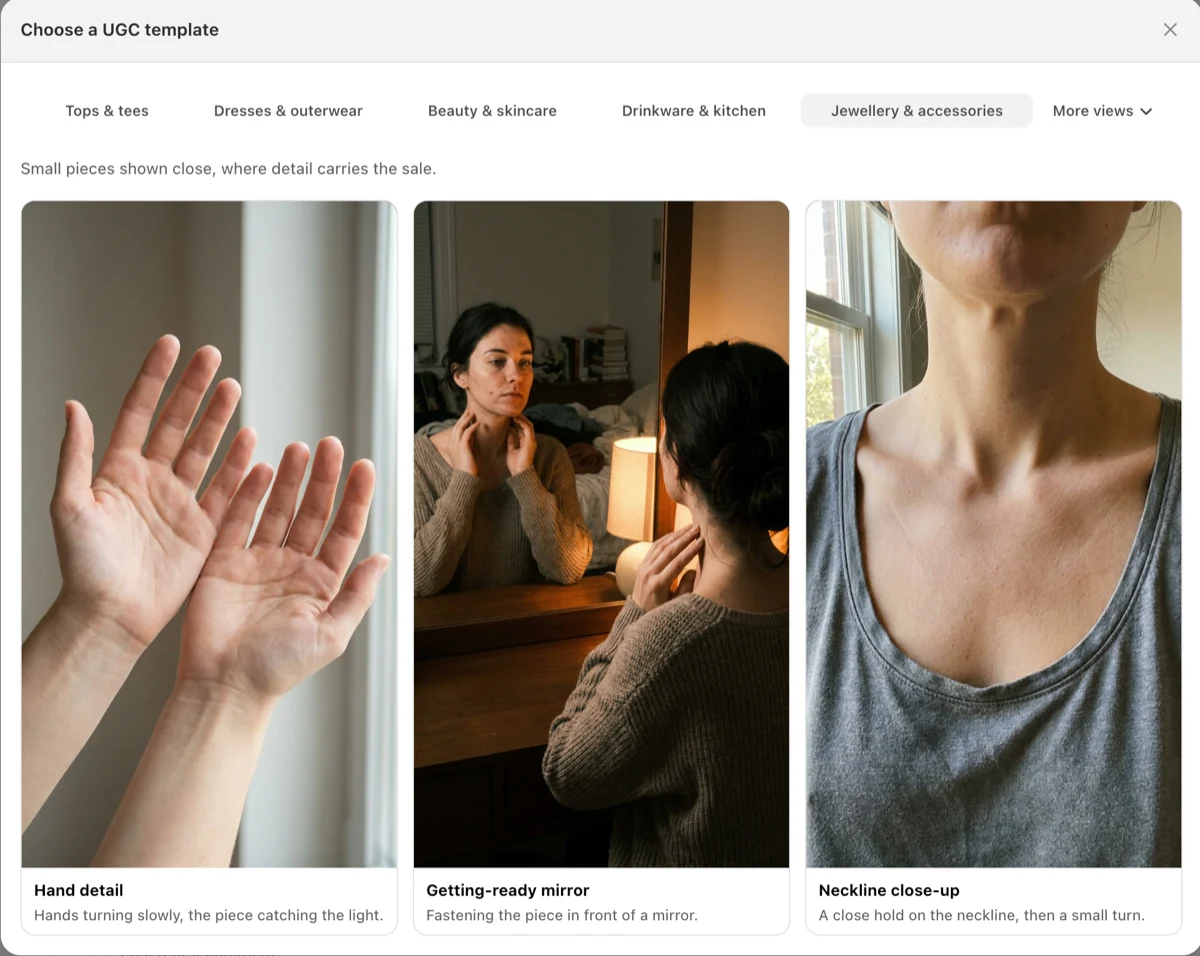
Each scene makes either a still or a five second clip. An AI image costs 15 credits and a clip 50, from a monthly allowance that also pays for AI captions at one credit each: 50 credits on Free, 250 on Starter, 700 on Growth and 1,500 on Pro. The still publishes anywhere, including Pinterest and Google Business Profile, which do not take generated video. Posts carrying an AI clip get a "Created with AI" line in the caption by default, which you can reword or switch off.
Three honest limits. Three scenes is three scenes: we authored them once, so every shop using the category gets the same person, and they supplement your photography rather than replace it. Generation costs credits, so it suits new pieces and best sellers rather than a thousand SKUs. And nothing in the app can tell you whether your stone came out the right colour: that judgement is yours, on every image.
The free plan publishes real posts rather than previews, and the feature documentation is at yoomru.com/documentations. For how Yoomru compares with other apps, including where it loses, we tested nine competitors hands on in the best Shopify social media auto-post apps.
Checklist before you post
- The piece appears on a body, or next to something that gives its size away.
- The caption states the metal, the stone and the measurement that matters: length, drop, width.
- The metal colour in the image is the metal colour that ships.
- Any karat, fineness or stone claim carries its qualifier immediately before the name.
- There is a version cut for the shape of the channel: 9:16, 4:5 or 2:3.
- The link goes to the product or collection page, not the homepage.
- Something from the back catalogue is scheduled this week, not only new work.
FAQ
Which platform is best for a small jewelry business?
Instagram, then Pinterest. Instagram is where a jewellery brand builds a recognisable look and where buyers check you out before ordering. Pinterest is where people planning a wedding or a gift find shops they have never heard of, and it keeps paying for months after you publish.
How do I get customers for a jewelry business without a budget?
Answer the objections in public: post scale, length, metal and care content, ask your buyers for photos, answer inbox questions where everyone can see the answer, and show the piece being made. Gifting product to influencers is what most shops try first, and it is effectively a paid channel with an unreliable payout, so do it after the free things rather than instead of them.
Do jewelry hashtags still work?
They help a little with discovery and not much with reach, and they are no substitute for a description. Use a handful that genuinely describe the piece, the material and the occasion, and never let a hashtag do the work of a required disclosure: mixing natural and lab-grown terms in a hashtag pile is exactly the pattern regulators have called out.
Should I automate posting?
Automate the repetitive half: sending each new piece to every channel, keeping the back catalogue circulating, filling the quiet weeks. Keep the rest human: replying to questions, judging whether an image is good enough, checking every claim about metal and stones. Automate the schedule, not the judgment. More in avoiding spammy social media posting.