
 Facebook
 Instagram
 X (Twitter)
 TikTok
 Pinterest
 YouTube
 LinkedIn
 Threads
 Google Business Profile
 Telegram
 Discord
How to Market a Skincare Brand on Social Media: A Guide for Small Shops


A skincare bottle photographed on white looks exactly like every other skincare bottle photographed on white. The label is the only thing that differs, and a label is not what makes someone stop scrolling. What sells skincare on social media is a face, a hand, a routine, something that shows the product actually being used rather than merely existing.
That single fact shapes almost everything else in this guide: which channels are worth the effort, what to post instead of another flat-lay, how reviews carry more weight here than in most categories, and a weekly workflow that does not require you to be a full-time creator. Yoomru, the app we make, appears near the end where it is relevant, and we say so clearly.
Quick answer
Put Instagram first for the routine and result content, TikTok second for reach among a younger, more discovery-driven audience, and treat reviews as content, not just as trust signals. Show the product in hand or in use far more often than on a shelf. Ingredients and results earn trust; brand voice alone rarely does, in a category this saturated with claims.
| Channel | Why it matters for skincare | Realistic effort |
|---|---|---|
| Reels carry routines and before-and-afters; Stories carry the day-to-day, less polished side. | Four to five posts a week, plus daily Stories. | |
| TikTok | The platform where skincare content genuinely goes viral, on the strength of a result or a texture shot, not production value. | Three to four clips a week. |
| Routine graphics and ingredient breakdowns get saved for later reference, though it moves slower than the other two here. | A few pins a week. | |
| An older, often loyal audience for established or medically-adjacent skincare brands specifically. | Two posts a week, mostly reshared. | |
| Google Business Profile | Only relevant with a physical counter, spa or clinic presence. | Occasional. |
Why skincare is a harder sell than it looks
Skincare carries a credibility problem most product categories do not: everyone has been sold a miracle claim before, and everyone has been disappointed by one. A post that leads with "this changed my skin" from a brand's own account is, correctly, met with skepticism. The same claim from a customer's own account, or shown as a visible texture and result rather than stated as a claim, earns belief a brand voice cannot buy.
The category is also intensely visual in a specific way: buyers want to see texture (does the serum sink in or sit on top), application (how much, how it is layered with other products) and skin type match (does this look like it was made for my skin, not a model's). A single glamorous product shot answers none of these questions, which is why skincare content built purely around aesthetics tends to underperform content that looks almost like a tutorial.
There is also a slower purchase cycle hiding under the impulse-scroll surface. Someone rarely buys a new serum the first time they see it; they watch a few posts, read a few reviews, maybe see the same product mentioned by two different accounts, and then buy. That means consistency over weeks matters more than any single viral moment, and a brand that posts once and waits for it to convert is optimizing for the wrong thing.
Ingredient literacy has also risen sharply among skincare buyers, even casual ones. A caption that says "with hyaluronic acid" without saying what that ingredient actually does reads as filler to a buyer who has seen the phrase a hundred times before. Specificity, in plain language, is what now separates a credible post from marketing noise.
Product tagging matters more here than in most categories too. Wherever the platform supports it, tag the exact product in the post so a viewer three scrolls deep in a routine video can reach the product page without hunting through a profile or a bio link. A genuinely persuasive video that makes purchasing difficult loses most of the interest it just earned.
Where to put your effort, channel by channel
Instagram is where the routine lives: Reels for the morning or evening sequence, carousels for a step-by-step breakdown, and Stories for the less polished daily moments (a quick swatch, a poll about what to restock). This is also where most skincare buyers expect to find a brand's actual personality, not just its product catalog.
TikTok rewards a genuine result or a satisfying texture shot over production value, and it reaches people who have never heard of the brand before, which Instagram's more closed, follower-based feed does less reliably. A single honest, slightly imperfect video here can outperform a fully produced one.
Pinterest moves slower but compounds: routine graphics, "what order to apply your products" infographics and ingredient breakdowns get saved for reference and resurface for months, closer to how a buyer researches skincare than how they discover it.
Facebook still carries real weight for a brand with an older or more medically-conscious audience, particularly anything framed around a specific skin concern (sensitivity, rosacea, aging) rather than pure aesthetics. Treat it as a reshare channel from Instagram rather than a separate content source.
What a skincare brand actually posts
- The product in hand or in use. Applied to skin, held at the counter, mid-routine. Sitting on a shelf is the least persuasive place a skincare product can be shown.
- Texture close-ups. A swatch on the back of the hand, blended with a fingertip, shows viscosity and finish in a way a bottle photo cannot.
- Routines, not single products. Where this fits in a morning or evening sequence, and what it pairs with, matters more to a buyer than the product in isolation.
- Reviews with photos, prominently. A visible, unedited customer photo does more trust-building work per post than almost anything a brand can produce itself.
- Ingredients explained simply. Not a full chemistry lecture, but a plain-language answer to "what does this actually do and why."
- Before-and-afters, handled carefully. Genuinely powerful when real and clearly disclosed as an individual result; the fastest way to lose trust in the category when they read as staged or exaggerated.
- The founder or team, occasionally. A short clip of who actually makes the product, especially for an indie or small-batch brand, gives a face to a category people are otherwise wary of trusting blindly.
- Answers to real questions. "Can I use this with retinol," "does this work on oily skin," pulled straight from comments and DMs. This content writes itself and answers the exact objection stopping a purchase.
Notice what is missing from this list: a plain announcement that a product exists, with no context beyond its name and price. That post type performs worst in this category almost every time, because it gives a skeptical buyer nothing to evaluate.
Showing the product in use without hiring a model for every post
The obstacle is not creative direction, it is volume: a real routine shoot for every product, every week, is not realistic for a small skincare brand, and a single hero video gets reused until it feels stale. An AI-composited image solves the volume problem specifically, not the whole problem: it puts your exact product in a persona's hand, at a counter or beside a mirror, from the plain bottle photo you already have for the product page.
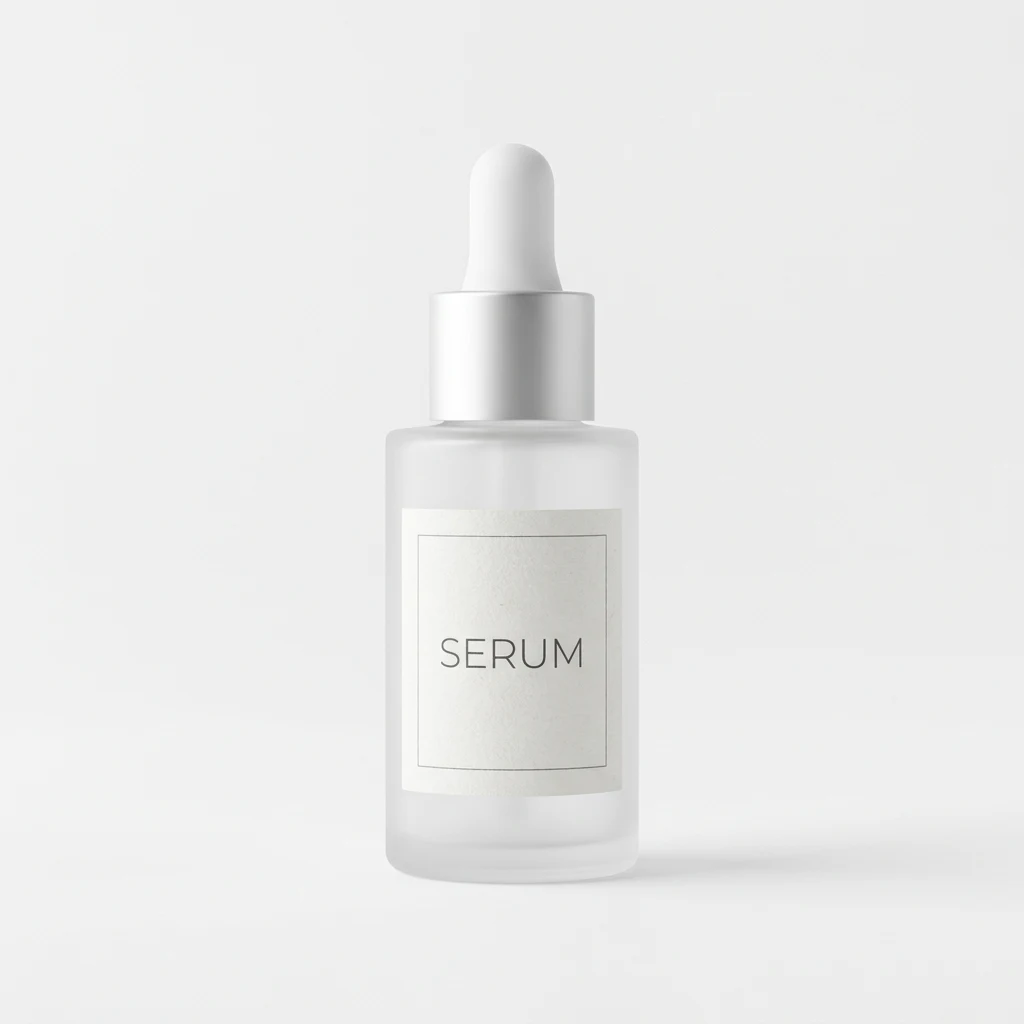
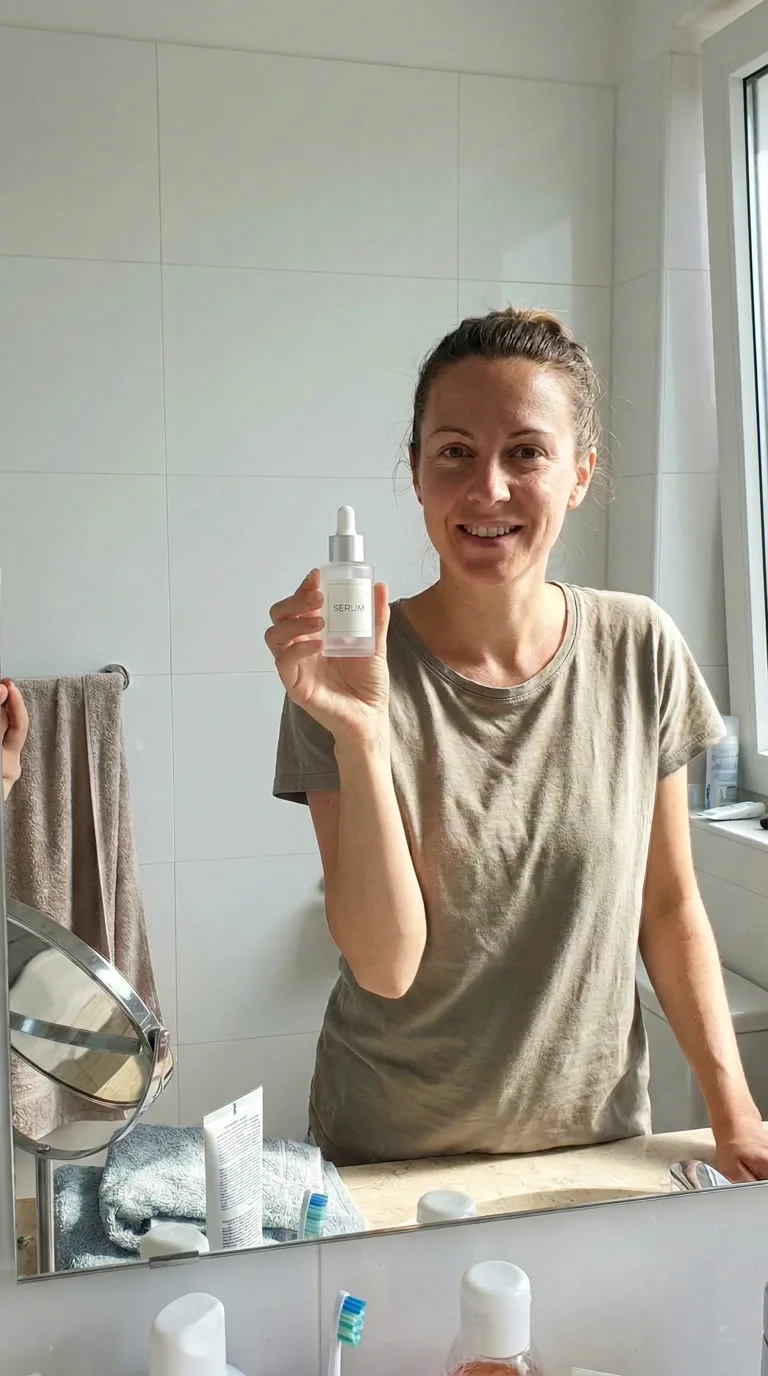
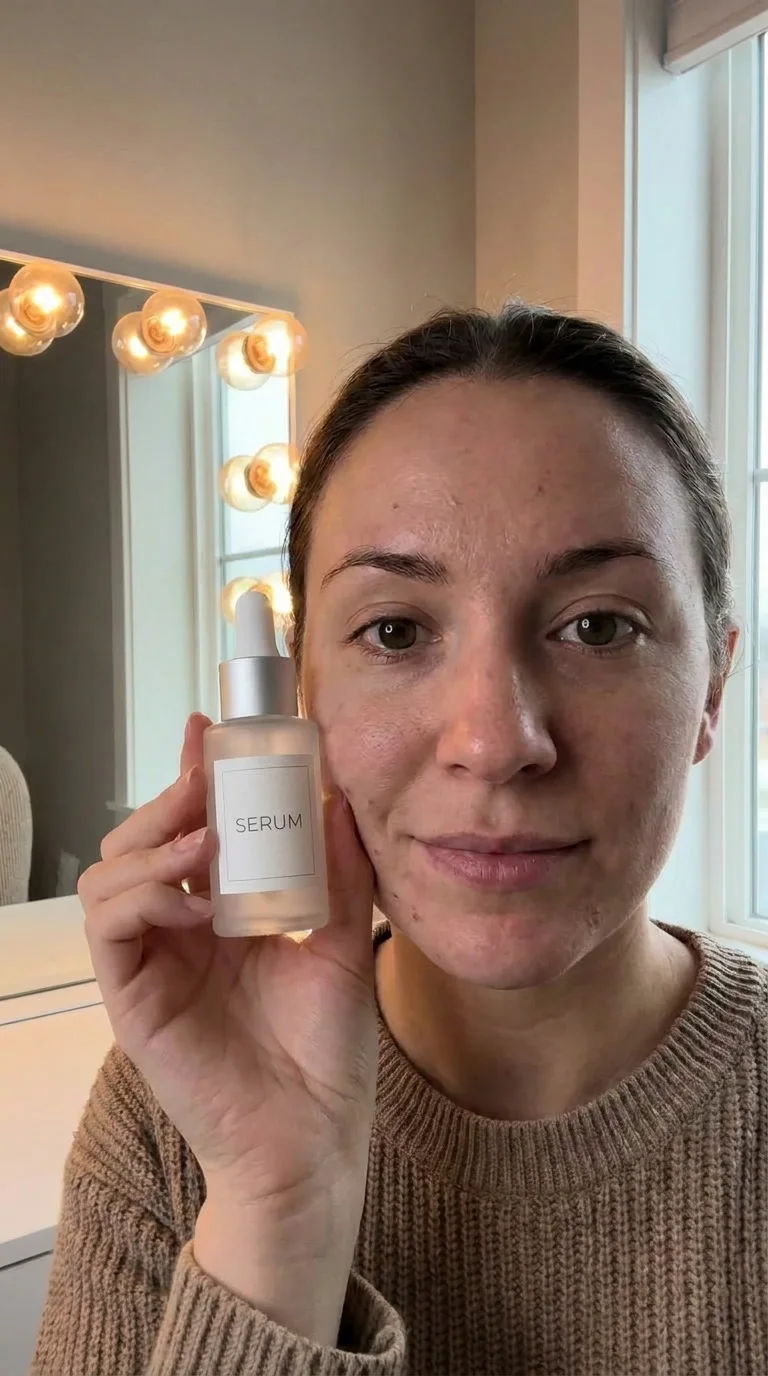
Same bottle, same label, two different moments. Neither replaces a genuine routine video from a real customer, but both replace the flat product photo that would otherwise carry the post, and they take minutes rather than a shoot.
How often to post, and a weekly workflow
| Day | What goes out |
|---|---|
| Monday | A routine reel: this product in its place in a morning or evening sequence. |
| Tuesday | A texture or swatch close-up, on Instagram and TikTok both. |
| Wednesday | A review card or a genuine customer photo, given real prominence rather than buried in Stories. |
| Thursday | An ingredient explainer, plain language, one ingredient at a time. |
| Friday | A counter or in-hand product shot, the lightest lift of the week for a day that needs one. |
| Weekend | Stories only: behind the scenes, a quick poll, a restock note. |
Batch the creative work rather than producing daily: shoot or generate a batch of in-use images and a few routine clips in one sitting, write the captions in another, and let a scheduler carry the actual posting. The routine itself does not need to be live to feel authentic; a routine filmed once and posted across a week reads exactly the same to a viewer as one filmed fresh each day.
Keep a running list of the questions customers actually ask, in comments, in DMs and in support emails, and treat it as your content calendar's backbone. A brand that answers its own real questions publicly, before being asked again, looks more credible than one that only ever posts polished announcements.
Ingredient content, done briefly
A single ingredient, explained in one or two sentences, plain language, no chemistry degree required, is one of the highest-performing and lowest-effort post types in this category. "Niacinamide calms redness and helps even out tone" tells a buyer something real in under ten words. Save the fuller ingredient breakdown for the product page or a pinned FAQ; the social post's job is to make one person curious enough to read further, not to be the full explanation.
Rotate through your formula's actual ingredients over weeks rather than repeating the same one or two headline actives. A buyer who only ever hears about the one ingredient on the label misses everything else the product is doing, and a slower ingredient reveal gives you months of content from a single formula.
Reviews carry unusual weight in this category
Skincare results are invisible until someone shows you their skin, which is exactly why a review with a photo does more work here than in almost any other category on Shopify. A five-star rating on its own is a number; a review with a photo and a sentence about what changed is evidence, and evidence is what a skeptical skincare buyer is actually looking for.
Treat your best reviews as a content source, not just a trust badge on the product page. A branded card built from a real review, with the customer's own words, posted with the same care as a product shot, regularly outperforms brand-authored content in this category specifically. Our guide to turning reviews into social proof covers this in depth.
Where Yoomru fits
Yoomru connects to your Shopify catalog and posts to Instagram, TikTok, Pinterest, Facebook and eight other networks from one place. Three features matter specifically for skincare:
- AI UGC scenes. Pick a product, pick a hold-mode scene (a counter routine, a hand swatch, a vanity close-up), and Yoomru composites your exact product into that moment in minutes, the technique behind the images above.
- Review cards. Turn a Judge.me review into a branded, shareable image automatically, so a strong review does not sit unused on the product page.
- Planners. Set a planner against your skincare collection or your best reviews, and it keeps posting on a schedule without daily manual work.
All three are available on the free plan for a limited monthly allowance, with more on paid plans. For the AI UGC side specifically, our guide to skincare UGC without influencers goes deeper into what these scenes can and cannot replace.
Mistakes to avoid
- Leading with the claim instead of the evidence. "This will transform your skin" invites skepticism; a texture close-up and a genuine review invite belief.
- Only showing the product on flawless skin. It quietly tells anyone with visible skin concerns that the product was not made with them in mind, which is the opposite of what most skincare brands intend.
- Burying great reviews in a highlights reel nobody opens. A strong review deserves the same production effort as a product launch post, not a second-tier placement.
- Overusing filters on skin content specifically. A heavily filtered "after" photo undermines the exact credibility a results post is trying to build.
- Posting inconsistently and expecting one viral clip to carry the account. Skincare's slow purchase cycle punishes gaps; a buyer who saw one great video two months ago and nothing since has likely moved on.
Checklist before you post
- Is the product being used or held, not just photographed alone?
- Does the caption explain what it does in plain language, not just brand adjectives?
- If there is a results claim, is it attributed to a specific, disclosed individual result?
- Is a recent, genuine review getting posted with the same care as a product shot?
- Would a skeptical stranger find this believable, not just attractive?
FAQ
Do before-and-after posts still work, given how skeptical people are of them? Yes, when they are real, specific and clearly labeled as one person's individual result over a stated time period, rather than presented as a guarantee.
Is TikTok worth it if I am uncomfortable being on camera? Texture shots, application close-ups and ingredient explainers using only hands and product perform well without ever showing a face, so being on camera is not a requirement.
How do I handle regulatory language around claims? Keep language descriptive rather than medical: "helps skin feel smoother" rather than a specific medical claim, and check your specific market's advertising rules for cosmetics, which vary by country.
What if I sell a men's skincare line specifically? The same principles apply; the visual language (routine, texture, plain-language ingredients) shifts in tone but not in substance, and reviews carry the same weight regardless of the audience.
How many products should one routine post feature? Two or three at most. A routine crammed with every product in the catalog reads as a sales pitch rather than an actual routine, and it dilutes attention away from the specific product you most want noticed.
Should I work with influencers, or is that a separate strategy from what this guide covers? It is a real and valid channel, but a separate one from what is covered here, which focuses on what a small brand can produce itself. Our guide to skincare UGC without influencers covers the specific alternative of AI-generated in-use content when an influencer budget is not realistic yet.
How do I keep a consistent look when routine content comes from different customers or personas? Anchor it with one consistent element instead of trying to control everything: the same caption structure, the same product photography style for the flat shots, or the same handful of AI personas reused across posts, so the account still reads as one brand even as the specific in-use content varies.